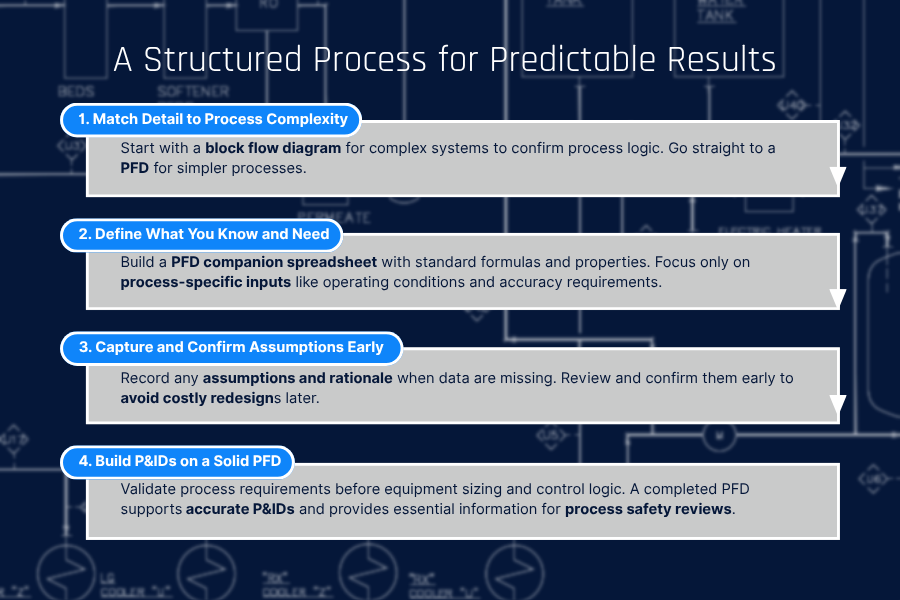
The reality is stark: each project phase where a design issue goes unchecked can add an order of magnitude or more to the cost of correction. A process definition error that could be resolved with a simple P&ID revision during design might require complete equipment replacement if discovered during startup.
Here are the most common piping design mistakes and proven strategies to avoid them before they reach the field.
Why Design Mistakes Are More Costly Than Ever
Several industry trends make design errors increasingly expensive and harder to recover from:
Compressed Project Timelines: Accelerated schedules leave less time for thorough design reviews and field corrections. Design teams are often brought in later than optimal, forcing reactive rather than proactive approaches.
Limited Downtime Windows: Getting production downtime for installations has become increasingly difficult. Operations can’t afford extended shutdowns, making first-time accuracy critical.
Higher Material and Labor Costs: Rising costs make field rework and change orders more expensive than ever. What might once have been manageable rework can more easily derail project budgets.
Aging Workforce: Less experienced operators need more intuitive, accessible designs. Systems that technically function but are difficult to operate create ongoing safety and efficiency problems.
The Five Categories of Design Mistakes
1. Starting Design Before Process Definition is Complete
The Problem: Beginning detailed design while process requirements are still evolving leads to constant rework and misaligned systems.
Common Manifestations:
- P&IDs changing during 3D modeling
- Equipment sizing revisions after procurement
- Control system logic conflicts discovered during startup
- Safety system inadequacies identified during commissioning
Prevention Strategy: Lock process definition before detailed design begins. Establish clear gates between process engineering and piping design phases. When timeline pressure forces overlap, maintain formal change control processes.
2. Ignoring Field Constraints and Installation Realities
The Problem: Designing without understanding existing conditions or construction limitations creates unbuildable layouts.
Common Manifestations:
- Equipment installation plan incompatible with access and rigging limitations
- Designs that assume perfect structural alignment vs the reality of field tolerances that compound over distances
- Pipe routing that ignores secondary infrastructure and realistic access for welding
- Piping routes that conflict with access to existing equipment operations and maintenance
Prevention Strategy: Begin with accurate field verification through laser scanning and comprehensive field surveys. Validate all tie-in points and clearances before finalizing routing. Consider construction sequence and equipment access during layout.
3. Inadequate Stakeholder Coordination
The Problem: Designing without early and continuous input from operations, maintenance, and construction teams creates systems that may function technically but fail operationally due to misaligned priorities, incompatible materials, and impractical layouts.
Common Manifestations:
- Material choices that conflict with established maintenance practices and spare parts inventory
- Design decisions that don’t reflect actual operational procedures
- Over-specification of secondary systems while under-investing in critical operational equipment
- Maintenance requirements identified only during construction or startup
- Instrument locations that don’t align with operational needs
Prevention Strategy: Engage operations and maintenance teams from project start to understand established practices, spare parts inventory, and operational priorities. Conduct regular design reviews to validate material choices, equipment specifications, and access requirements. Align project investment with operational criticality and maintenance realities.
4. Design Software Misuse and Over-Reliance
The Problem: Using design software without proper specification setup or treating automated outputs as construction-ready without validation
Common Manifestations:
- Visually impressive models that can’t generate constructible documentation
- Auto-generated outputs accepted without quality control checks
- Component selections driven by software defaults rather than validated project specifications
- Placeholder or generic components used where exact dimensions are needed for fabrication
Prevention Strategy: Set up software with properly engineered, project-specific specifications. Validate all auto-generated outputs through quality control checks. Use actual component dimensions rather than placeholder shapes. Manually review deliverables for constructability and fabrication readiness.
5. Poor Quality Control and Documentation
The Problem: Inadequate quality control and document management processes allow errors to propagate through design phases while creating disconnects between design intent and field reality.
Common Manifestations:
- P&IDs that lack validation or change management, creating misalignment with design
- Construction documents that rely solely on drawings without supplementary field imagery for installer reference
- Version control failures leading to outdated drawings in the field
- Quality control processes that check individual deliverables but miss system-wide inconsistencies
- Field changes not captured in final documentation, leaving future teams with outdated information
Prevention Strategy: Establish P&ID validation and change management processes to maintain design alignment. Supplement construction drawings with field imagery and installation context. Implement systematic quality control that validates both individual deliverables and system-wide consistency. Maintain rigorous version control and capture all field changes in final documentation.
The Prevention Mindset
The most effective approach to avoiding design mistakes isn’t about perfect execution. It’s about building systems that catch and correct problems early. This requires:
Early Integration: Bringing together process, mechanical, and operational perspectives from project start rather than trying to coordinate after designs are complete.
Reality-Based Design: Starting with accurate field conditions and maintaining connection to construction and operational realities throughout the design process.
Systematic Validation: Implementing checking processes that verify design intent against project requirements at each milestone.
Continuous Communication: Maintaining alignment between all project stakeholders through regular reviews and updates.
The goal isn’t eliminating all mistakes. It’s catching them when they’re small, inexpensive problems rather than letting them grow into project-threatening issues.
The Discipline of Design Verification
Beyond having the right mindset, preventing design mistakes requires systematic verification built into every step of the process. This requires discipline around fundamentals that seem obvious but are frequently overlooked.
The P&ID Reality Check
One of the simplest yet most commonly missed verification steps is ensuring your 3D model matches the P&ID completely. The P&ID serves as the authoritative process definition that guides all design decisions. Yet anyone who’s been in the industry long enough knows this simply doesn’t happen consistently in practice.
It’s surprisingly common to find models missing critical elements. We’re not talking about small items like reducers or drain valves, but entire branches, instruments, or even major process equipment. The fix is straightforward: systematic line-by-line verification between P&ID and model. It simply requires time and attention to detail.
This same verification discipline applies across all design documentation. Successful projects require treating checking not as a final step, but as an ongoing discipline throughout the design process.
Avoiding costly design mistakes requires systematic processes, early stakeholder alignment, and disciplined verification at every step. The difference between drawings that look correct and systems that actually work lies in this attention to detail and commitment to getting the fundamentals right.