EMPLOYEE SPOTLIGHT · TEN YEARS
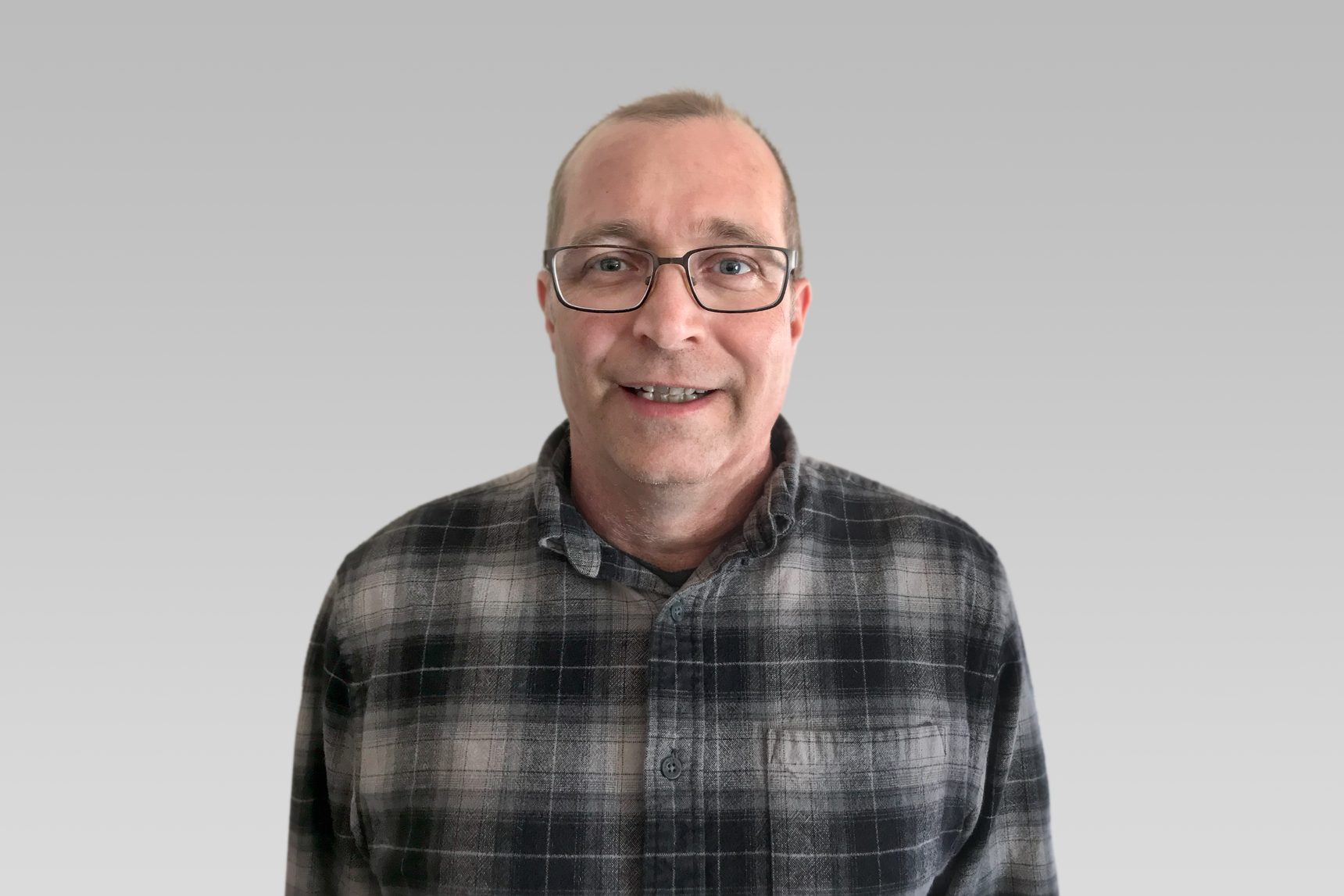
On July 1, 2016, Chris Leininger started at C-P Systems as a computer-aided design (CAD) technician. Ten years later, he works as a piping designer and one of the company’s laser scanning technicians, and he is still chasing the next project. “I didn’t even realize it’d been that long,” he says of the milestone. “It seemed to just fly by.”
Chris measures his career in decades. After earning a chemical engineering degree from the University of Minnesota, he spent ten years in the Air Force as a project engineer and operations officer, including time in Space Command at a launch facility in Florida. When he returned to civilian life, he wanted work connected to his chemical engineering roots. He picked up an Engineering CAD Technology degree from Hennepin Technical College, spotted an ad for a piping design opening at C-P Systems, and went in for an interview. He remembers the reaction on the other side of the table: “Where have you been? We’ve been looking for someone with your exact background.” He took the job.
He arrived with a recommendation to match. Rick Montzka, Engineering CAD faculty at Hennepin Technical College, kept Chris’s engineering logbook to show future classes, and put it plainly to C-P Systems at the time.
“Chris is a rare student. He is educated. He is driven. He does great work.”
RICK MONTZKA, ENGINEERING CAD FACULTY, HENNEPIN TECHNICAL COLLEGE
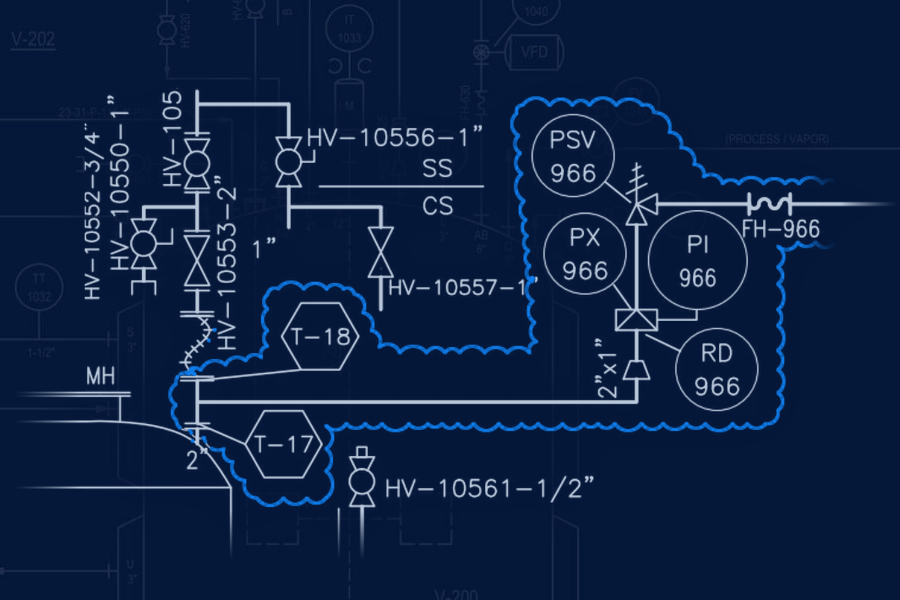
Ask Chris what a piping designer does, and he describes a familiar scene: a person brings home a flat-pack desk, dumps the parts on the floor, and starts assembling from the picture on the box. Frustration follows, because nobody opened the instructions. “Well, that’s what I do is make those instructions,” he says. His construction drawings show pipe fitters and installation crews exactly how to connect the tanks, reactors, pumps, and ovens that move material through a plant. “That’s my goal. Let’s make sure they have all the information they need so they can put it together properly.”
He has carried that goal across a remarkable range of industries: industrial adhesives, roofing tile, dairy, even paper made from a clay slurry. At one plant he learned how sponges get made, and he still tells the story. They come off the line the size of a queen mattress. Salt crystals form inside the material as it sets, a rinse dissolves the salt to leave the holes behind, and the crew collects the same solution to reuse on the next batch. At a dairy facility, he laser scanned the entire processing plant, a job that took about a week. The variety keeps him here, and so do the people. “Really good team to work with,” he says, colleagues who share what they know and help the moment you ask.
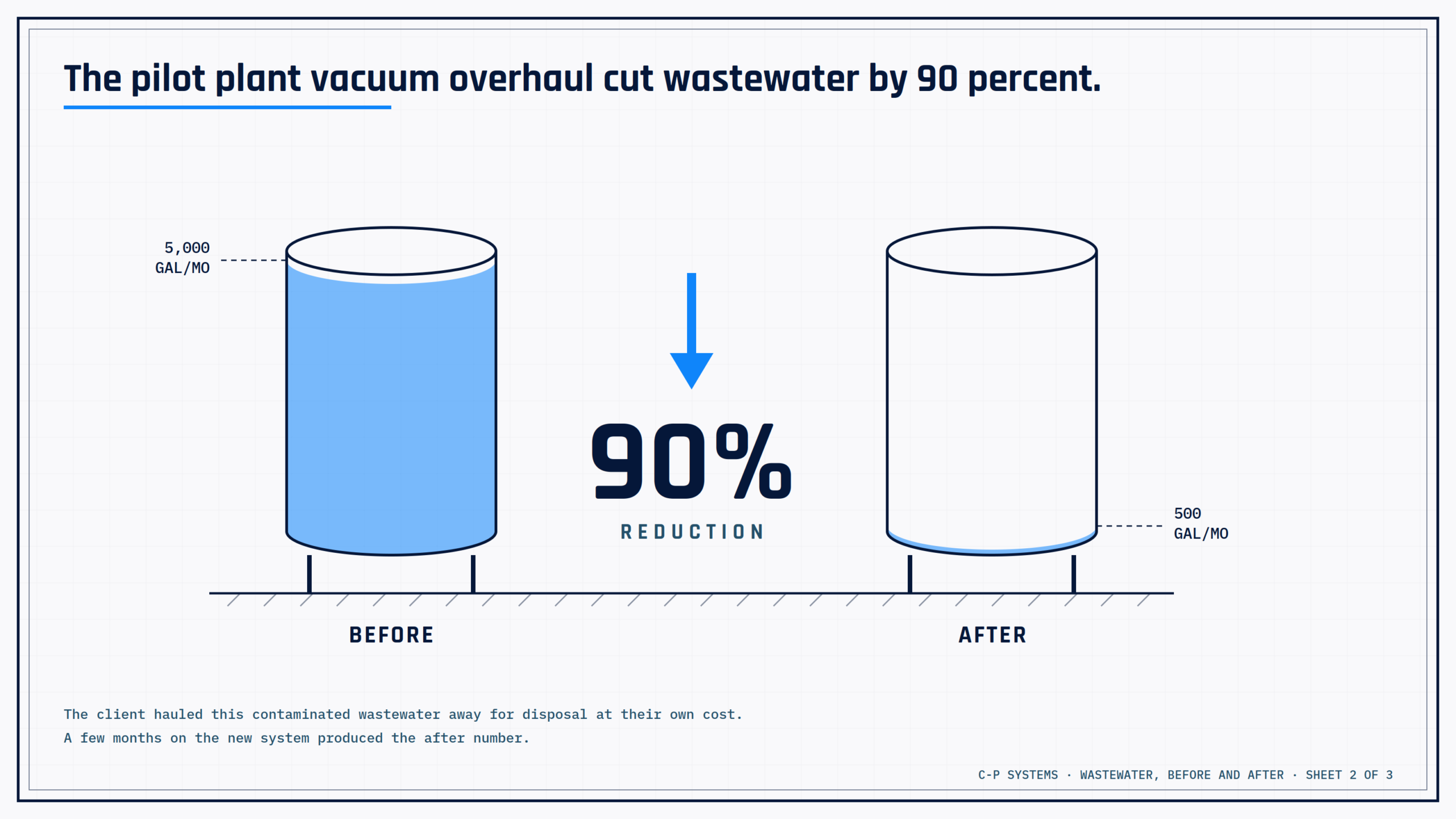
One project stands out. A client’s pilot plant relied on an antiquated vacuum system to pull water out of their product ahead of a drying oven, and the old unit ran constantly and wasted water. Chris worked on the replacement, an effort that grew into an overhaul of the reactor and the drying setup around it, and the client’s monthly wastewater dropped by 90 percent. They liked the outcome enough to ask C-P Systems to add a second oven to the same processing area. Ten years in, that is the kind of impact Chris likes to design for.
Nobody crawls under sixteen tons of concrete.
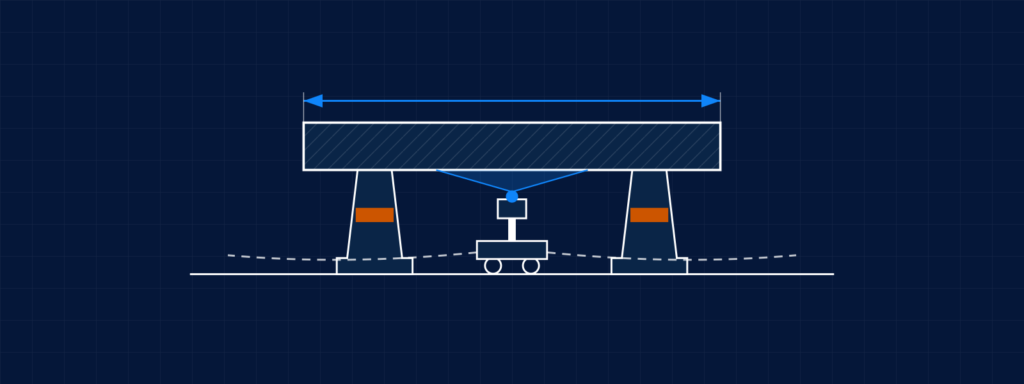
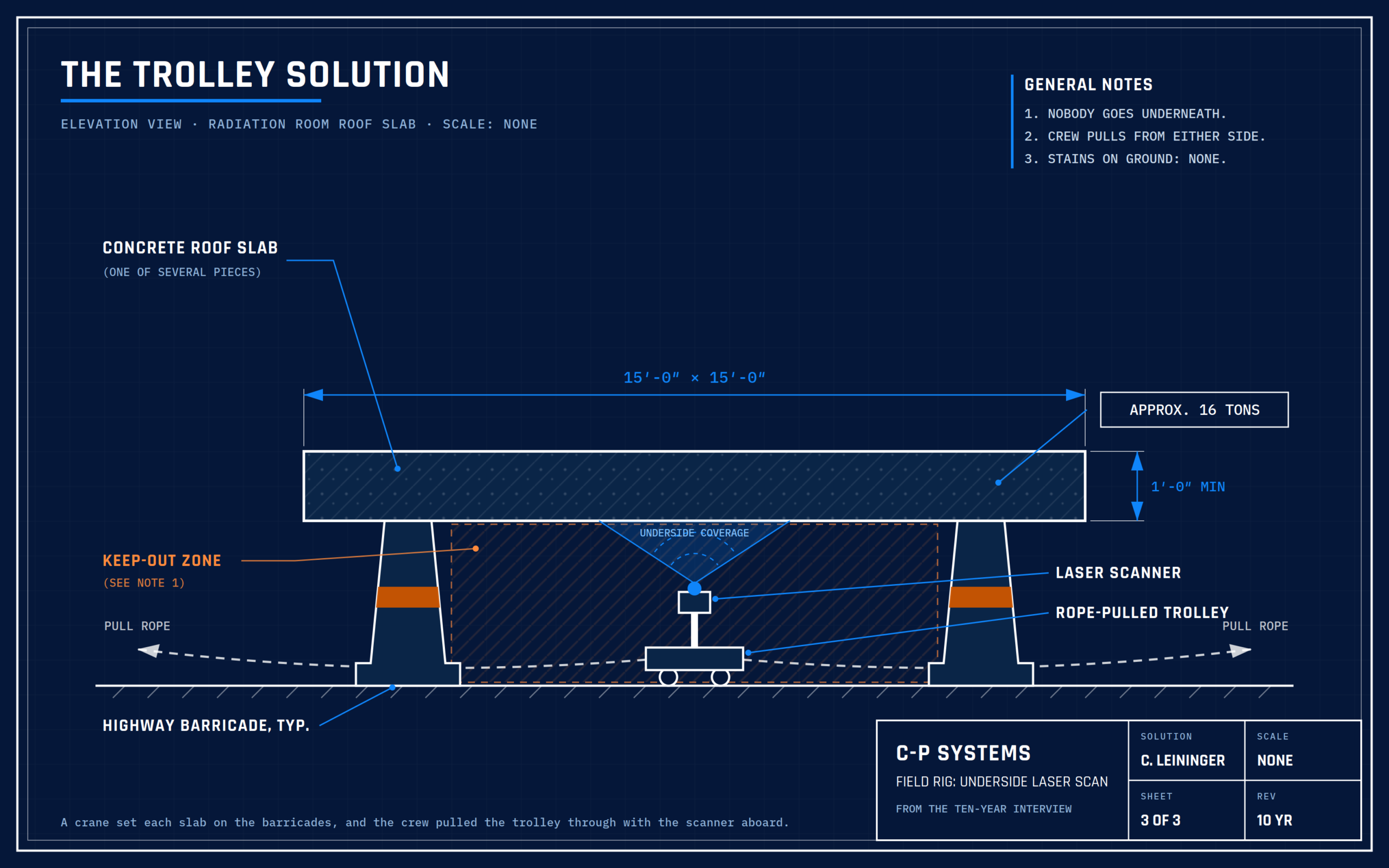
Then there is the trolley story. A customer built a radiation-shielded room for a medical product line, cut a hole in the roof to lower equipment inside, and capped the opening with stepped concrete slabs. They needed laser scans of every face of every slab, including the underside, and nobody wanted to crawl beneath a suspended slab that size. “This thing falls on you, you’re just a stain on the ground,” Chris says. He remembered a rope-pulled trolley the team had built years earlier to scan the inside of a glass-making oven. The drawing below shows how the rig worked, and every person stayed out from under the concrete. Chris downplays the whole thing. “I had to sit down and think about that for a little while before I came up with that idea.”
Chemical facilities rarely rattle him. In the Air Force he worked around launch fuels like hydrazine, and after that, a chemical plant seems manageable. Walking into one, he figures, “It’s not as bad as going through a hydrazine cloud, so I guess this is okay.” Heights still get his attention, though. He once hauled a scanner and tripod up the ladders of a set of seed oil storage tanks. “That was not my favorite moment. But I did it.”
“It’s not as bad as going through a hydrazine cloud, so I guess this is okay.”
CHRIS LEININGER, ON CHEMICAL PLANTS
The company grew around him.
When Chris started, C-P Systems ran with nine people, and many of them carried a second role: Chris managed the office supplies, one engineer doubled as the IT department, and another handled the accounting. The headcount has nearly doubled since, dedicated staff now own those roles, and the engineers get to focus on engineering. The biggest shift in the design work itself has been laser scanning. Light detection and ranging (LIDAR) lets the team spend a day or a week on site and produce a 3D image of an entire process area. Every discipline works from the same model: piping, electrical, structural, the contractors, and the customer’s own project managers. Designers once depended on construction drawings that could be fifty or sixty years old, plus repeated site visits for measurements. Now they overlay the construction model on the scan and catch interferences before anyone cuts pipe.
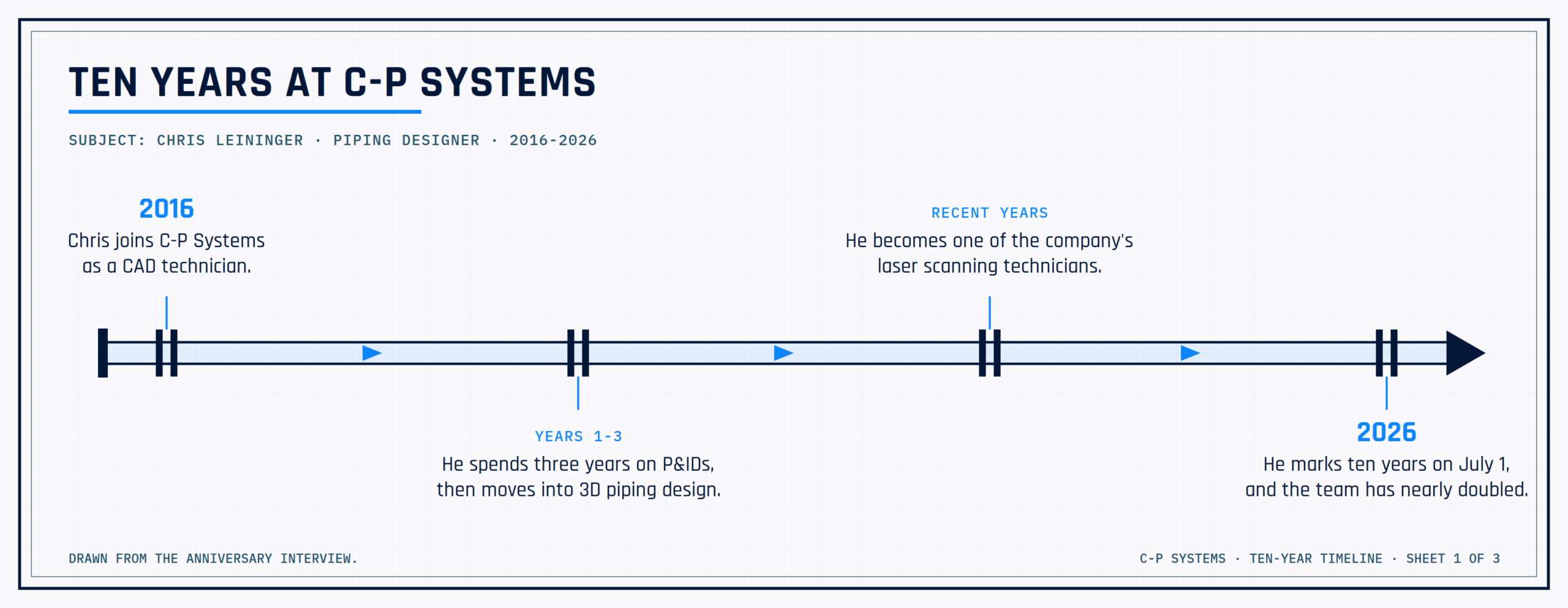
His advice for anyone entering the field starts with patience. Learn one aspect at a time; Chris spent his first three years on piping and instrumentation diagrams (P&IDs) before moving into 3D modeling. Then learn every software platform you can. “Learn as many of them as you can, because the more of them that you are able to use, the more value you’re gonna add to anywhere you work.”
As for what comes next, Chris jokes that retirement sits about ten years out. The real answer sounds more like him: “I like working on a project, but I like wrapping it up and getting started with a new one. Let’s figure out this one.” His favorite part of the job has stayed constant for a decade. “Seeing the finished design,” he says. Designers rarely get to stand in the finished plant, and Chris has done exactly that on most of his projects, watching operators put his drawings to work. “That’s pretty cool.”
Golf, lakes, and a Weimaraner fill the off hours.
Away from work, you will find him outdoors. He golfs through the Minnesota summer and hikes around lakes and rivers with Samson, his young Weimaraner, always scouting spots where a dog can truly run off leash. The small fenced dog parks hold no appeal for him: “It might as well be a fenced backyard. I got that at home.” He handles winter differently. “Since I live in Minnesota, I hibernate in the wintertime,” he says, though he still makes himself get outside. Samson, for the record, earns a fair review from his owner: “In spite of his owner’s inexperience with training animals, he’s a pretty good dog.”
“Since I live in Minnesota, I hibernate in the wintertime.”
CHRIS LEININGER, ON THE OFF-SEASON
Congratulations, Chris, on ten years of drawings, scans, and problems worth solving. All of us at C-P Systems look forward to seeing what you figure out next.