Front-end loading (FEL) is a structured, stage-gate engineering approach used during the front-end engineering design (FEED) process to ensure capital projects progress with clarity and control. In a stage-gate approach, work is divided into defined phases, or stages, with formal decision points, or gates, between each stage. At each gate, teams review the level of engineering completed, evaluate cost and risk, and determine whether a project should move forward, be refined, or paused.
FEL applies this methodology specifically to the front end of a project, where scope is defined, major uncertainties identified, and cost estimates developed. By breaking early engineering into progressive phases commonly referred to as FEL-0 through FEL-3, the process helps organizations make informed investment decisions before committing to detailed design or construction.
While the terminology is widely used, there is no single governing authority defining what must be included in each FEL stage. That flexibility makes the FEL process adaptable, but it also makes setting clear expectations from day one essential.
The Real Purpose of FEL
Oftentimes, organizations think the outcome of FEL is a package of engineering drawings. Instead, what is really essential at this stage is a cost estimate that can be trusted to use for key decision making. Therefore, the primary deliverable of the FEL process must be cost clarity, with preliminary drawings, layouts, and diagrams all serving as essential tools to develop that cost understanding.
To do this, scope and scope boundaries must be defined early in the process. These boundaries create the framework needed to develop meaningful cost estimates and evaluate project feasibility. Without this framework, even detailed engineering work can produce estimates that fail to reflect the true installed cost of a project.
Additionally, early FEL stages must identify major unknowns while spending the least amount of money possible so that business leaders can make informed decisions. If a project isn’t technically feasible, or site constraints such as utility capacity, fire protection, or infrastructure upgrades will dramatically increase costs, it’s far better to uncover these items early on than during detailed design or construction. Beyond determining if a project should proceed, pivot, or pause, at each stage, priorities should also be determined and right sized. This will ensure a lower priority item doesn’t get an outsized level of effort, budget, or physical space.
What to Expect at Each FEL Stage
FEL is not about over-designing early. It’s about applying the right amount of engineering effort at the right time to answer the right business questions. Misalignment usually happens when the level of detail expected doesn’t match the purpose of the stage. Below is an overview of how we approach each stage at C-P Systems
FEL-0
A screening-level evaluation where the focus is on identifying the opportunity, defining high-level scope boundaries, and developing an order-of-magnitude cost estimate. Deliverables might include a simple block diagram and rough layout considerations to help determine if the project is worth pursuing.
FEL-1
This stage builds on the foundation laid in FEL-0. Conceptual layouts begin to take shape, major equipment is identified, and early site and utility considerations are evaluated. While cost estimates narrow, they still carry a wide range (e.g. +100%/-50). The objective here is feasibility and alignment to confirm whether the project makes sense technically and financially before investing further engineering effort.
FEL-2
This stage moves into defined scoping. Deliverables such as process flow diagrams (PFDs) are finalized and preliminary P&IDs may be developed. Major hurdles such as power availability, fire protection, civil constraints, determining building occupancy classification, or site impacts should be identified and understood. Commercial availability of equipment, costs, and lead times are determined. Boundaries are clear, and the project scope is defined, but there are still assumptions and uncertainties.

FEL-3
The project now advances toward a basic design. P&IDs are developed to a higher level of completion, equipment selections are finalized or near final, and instrument and utility requirements are defined. Line sizes, nozzle orientations, and preliminary pipe routing are considered in enough detail to support a meaningful cost estimate. At this stage, the project should be fundable, meaning leadership has enough definition to make a capital commitment with confidence.
FEL-4
This stage covers detailed design and construction documentation. This is where the engineering package becomes fully constructible as P&IDs are issued for design, and ultimately construction, piping isometrics are produced, equipment drawings are finalized, and the construction package is assembled. For brownfield projects, tie-in details, demolition scope, and as-built reconciliation are part of this phase. The deliverable at FEL-4 is a package that a contractor can bid accurately and build from without needing to resolve open engineering questions in the field.
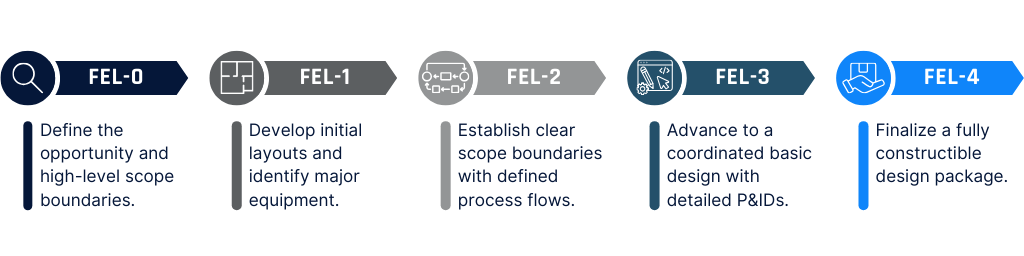
When expectations are clearly aligned for each stage, it becomes easier to see how the deliverables support the decisions being made.
These Are Guidelines, Not Rigid Rules
Because there is no single authority defining FEL, stages should be treated as guidelines tailored to the project. At the end of each phase, you should be able to select one of the following paths:
- Proceed
- Refine
- Rescope
- Pause
It’s also important to note that some projects may combine phases while some may “leapfrog” ahead to meet a fast-track schedule. But skipping steps doesn’t eliminate the need for the engineering work. In practice, teams will still end up performing work very similar to the FEED process outlined here only without the formal reviews and gates used to confirm priorities are aligned.
Regardless of how stages are structured or combined, the ultimate objective remains the same: provide the clarity needed for making confident business decisions. That clarity comes from understanding what truly drives installed cost.
Identifying the Real Cost and Schedule Drivers of a Project
During FEED, major cost and schedule drivers for a project should begin to surface. Early engineering helps teams pause and evaluate what factors will truly influence installed cost, project schedule, and physical layout before committing to a single design approach. Without this step, it’s easy to develop tunnel vision around one solution, even when alternative approaches may exist that better align with project goals.
In many cases, these drivers are tied to limiting factors within the facility or site. A process addition might initially appear straightforward until constraints related to utilities, infrastructure, codes, or facility layout come into view. For example, the building may not have sufficient water supply to support fire protection requirements, or the available electrical service may not be capable of supporting the new load. These types of constraints can significantly influence installed cost, project schedule, or overall project feasibility.
That’s why the purpose of early-stage FEL is to identify these boundaries and any limiting factors before too much time and money are invested and enthusiasm becomes a “runaway train.” It allows leadership to ask: Does this project still fit the business plan? If not, you’ve saved significant downstream engineering and construction costs.
The Role of Cost Accuracy
One of the biggest variables in FEL is the cost accuracy required to make decisions. Throughout the FEL process, each phase is intentionally calibrated to support the specific level of cost certainty required. For example, if a project requires +100%/-50% accuracy at FEL-1, it will require significantly less engineering definition than a ±20% estimate at the same stage. The level of effort, and associated cost, scale accordingly.
Therefore, the important question to answer at the beginning of a project is: What level of certainty do you need to make a decision?
If the goal is simply to determine whether what you believe is a $1 million project is actually closer to $3 million, you likely don’t need a fully modeled piping system to get this answer. On the other hand, if the project is moving into capital approval and funding release, tighter accuracy is required.
Making Better Decisions Earlier
Ultimately, the FEL process exists to improve project outcomes. Industries have matured toward stage-gate engineering because it produces more predictable estimates for project costs and schedules. It also helps teams identify unknowns early, align stakeholders, and avoid propagating mistakes into later phases where they become more expensive to correct.
It’s important to understand at the onset of a project that each stage has a purpose, a defined level of detail, and supports a specific level of decision-making. When these expectations are clearly set, and understood, FEL becomes what it was always intended to be: a structured, cost-effective path to confident capital decision making.
Talk with the C-P Systems team today about how early engineering guidance can help set up your project for success.