When you need to expand production capabilities, at first glance, creating an exact copy of an existing process seems like the fastest, most cost-effective option. After all, if it works in one plant or on one line, why not duplicate it somewhere else? But in reality, no two processes are ever truly identical, which is why copy-and-paste process design rarely leads to a successful outcome on its own. While this approach can serve as a useful starting point, treating it as a complete solution often introduces hidden risks, unexpected costs, and performance issues that only surface later in the project.
The “One Small Change” That Changes Everything
For most copy-and-paste projects, change starts with what seems like a minor adjustment. Maybe a new line needs to fit into a slightly smaller footprint, a new piping run needs to be a bit longer, or your new system has to move a liquid that is just a little more viscous. It’s these types of seemingly small changes that can quickly trigger a domino effect though.
Let’s look at a common example of trying to add a new line by copying-and-pasting the design of an existing line. While you may want the new line to perform all the exact same functions, the location within your facility actually requires a longer piping run that needs a larger pump. The larger pump changes flow rates and pressures, impacting downstream control valves. Higher pressures may mean new or resized relief devices are needed, while the pump’s increased horsepower may require a different electrical infrastructure or new drives.
See how what seemed like a simple duplication of an existing process is quickly becoming a redesign? Let’s now explore a few more common scenarios that add complexity when trying to perform copy-and-paste process design.
Accounting for Site Preferences
Oftentimes, companies want to duplicate a process between facilities, but operational differences and site preferences can quickly derail this type of one-to-one replication. For example, one site may prioritize operator control, allowing for manual intervention and flexibility, while another prioritizes automation and adding safeguards designed to reduce human intervention.
Neither approach is inherently right or wrong, but they do lead to fundamentally different system designs. Copying a process between sites without accounting for these different philosophies will result in a system that doesn’t align with how the plant actually operates, and will likely lead to inefficiencies, safety concerns, or operator confusion.
Physical Constraints Require Change
Even within the same facility, physical constraints make exact duplication nearly impossible. A new system may need to fit into an existing space that is shorter, narrower, or configured differently than the original space. As discussed above, adjusting the layout can change piping lengths, elevations, and routing, introducing new pressure losses and hydraulic conditions. This can lead to equipment that worked perfectly in one configuration no longer operating as intended in another.
Don’t Ignore Process Improvements
In many cases, teams don’t want a perfect copy of an existing process; they want a better version that eliminates known pain points or workarounds required in the original system. But, each improvement to address existing issues or inefficiencies will introduce change that can have cascading effects.
Adding a valve to improve drainage, for example, might alter how sections of the system can be isolated. That, in turn, can impact relief valve sizing or require additional safety devices. Similarly, upgrading instrumentation may introduce new interlocks in the control system, changing how operators interact with the process. These types of changes can lead to a new system that looks similar on paper but operate quite differently.
Similar Products Really Aren’t the Same
Another common pitfall with copy-and-paste process design is assuming a process can be duplicated to produce a similar product. Small differences in fluid properties, like viscosity or vapor pressure, can have major implications. Pumps may no longer be properly sized and the same filters or flow meters you’re currently using may not perform correctly. In more extreme cases, the product itself could introduce entirely new requirements. A process that previously handled non-hazardous materials may now need to accommodate flammable fluids, requiring classified electrical systems and additional safety measures.
The Hidden Complexities of Copying Documentation
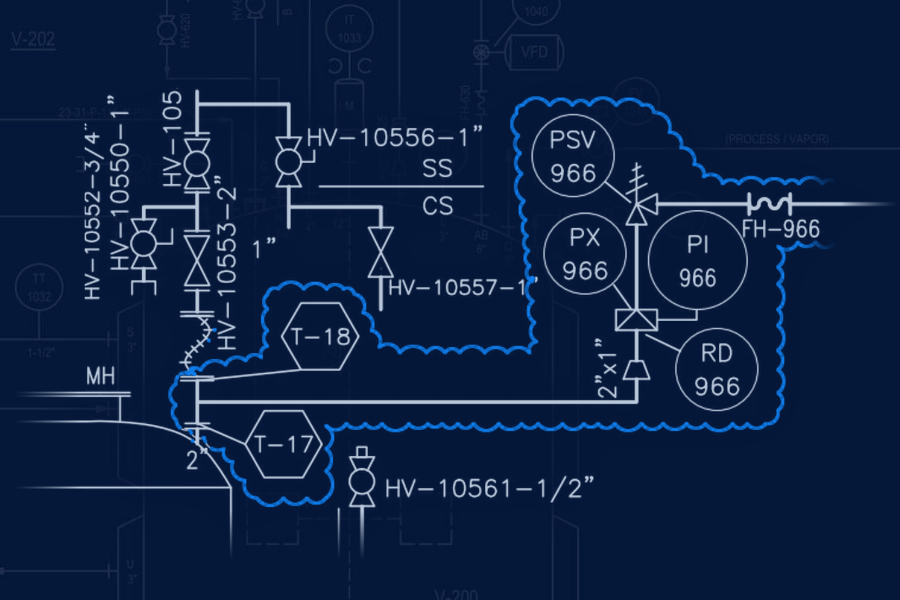
Even when physical and process differences are addressed, documentation and operator training can introduce another layer of complexity. When copying drawings, tag numbers from an existing system need a careful review to avoid inconsistencies and confusion. If you end up with two systems with identical tag numbers, this can create issues in control systems or maintenance workflows.
For operators, small differences between systems that are said to be identical can be even more problematic. A valve that behaves one way in System A may function differently in System B due to added interlocks or design changes. Without clear documentation, updated procedures, and proper training, these differences can lead to operational errors.
A Better Way to Think About Copy-and-Paste Process Design
Even with all these potential risks of copy-and-paste process design, it’s important to know that copying an existing process isn’t inherently wrong. In fact, it’s often a smart way to start a project. Using an existing process design can provide a baseline to help teams identify what works, what doesn’t, and accelerate early-stage planning.
But a copy of an existing process should never replace thoughtful engineering. Instead, treat a previous design as a reference point for the engineering team to come in and ask critical questions such as:
- What’s different about this site, this product, or this layout?
- What can be improved?
- What new risks may be introduced when changes are required?
While it may seem faster to duplicate what already exists, success will come from using a thoughtful approach to understand where a new process diverges from the original. Taking the time to think through those differences upfront is what separates a smooth project from one filled with surprises.